
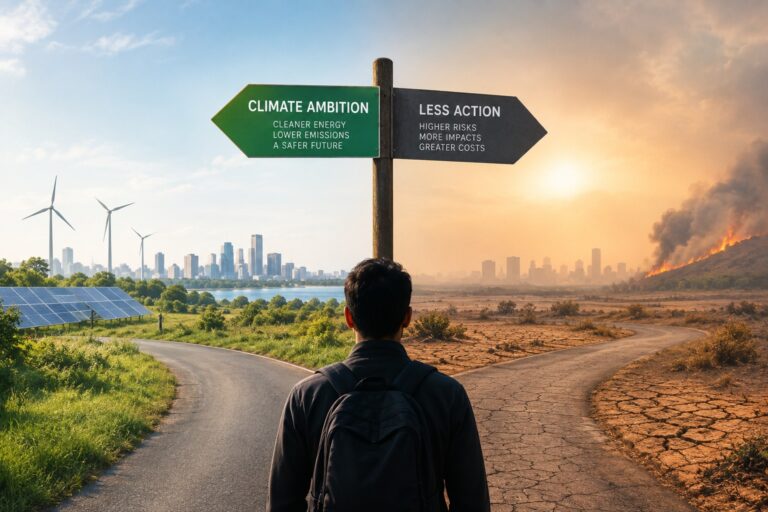
Could Dropping SSP5-8.5 Weaken Climate Ambition at CoP 31?
Scientists have recommended dropping the highest-emission scenario, the Shared Socioeconomic Pathway (SSP5-8.5). Why? Will it hamper consensus on escalating climate action at CoP 31 (Conference of Parties) due in November this year?
Scientific consensus holds that the SSP5-8.5 scenario is implausible, given a flattening greenhouse gas (GHG) emissions curve, falling renewable energy costs, and a stronger focus on climate mitigation policies. The annual growth rate of carbon dioxide emissions is declining; in 2025, global power sector emissions continued the downward trend, falling by 0.9% compared with 2024. According to the UN's Energy Progress Report 2025, global per capita installed renewable energy capacity has more than doubled from 155 to 341 watts since 2015. The International Renewable Energy Agency (IRENA) reports up to an 80% cost reduction in renewable energy production since 2010 and expects this trend to continue to 2035, though at a slower pace. Climate regulatory policies have helped lower GDP emissions intensity, promote vehicle electrification, and reduce deforestation. India has revised its GDP emissions-intensity reduction target for 2030 from 33% to 45%.
These developments and trends will feed into the Intergovernmental Panel on Climate Change (IPCC) 7th Assessment Report (AR7), due in 2028/29. IPCC reports inform governments, policymakers, and the global community about the state of the climate, the risks of global warming, and actions for climate adaptation and mitigation. These reports are organised around emission scenarios. Scientists construct these scenarios to project future global warming based on economic development pathways, technological development, and the adoption of climate policies by national governments.
Does dropping the SSP5-8.5 emission scenario signal the preclusion of apocalyptic climate change? No. Nonetheless, a new narrative has emerged in some quarters of developed economies advocating unconstrained economic growth. It alleges miscommunication of climate science and evidence, and asks: Have we been told more than the science actually shows? Have worst-case scenarios in the headlines enabled lobbies to pressure Western governments to constrain economic growth to the disadvantage of citizens? It also claims that doomsday headlines have left younger people anxious about future warming.
Phasing out the SSP5-8.5 scenario has implications for climate negotiations and action. The Western narrative of removing constraints on economic growth is likely to mainstream a shift in their position on climate change mitigation, thereby diluting their obligation to the Paris Agreement’s principle of ‘differentiated responsibility’. At the upcoming CoP, vested interests may try to shift the focus from developed countries' mitigation responsibility to adaptation by individual developing countries. This could relegate the need for direct climate action and climate justice to the background. Climate change would cease to be a global-level crisis and become a country-level issue.
IPCC messaging about the exacerbation of climate change is not misinformation. The intense heatwaves in Europe and the USA, wildfire-driven evacuations of more than 200,000 people in Canada, Spain and France, extremely low flows in the Danube River that forced the shutdown of Hungary's only nuclear power plant, which supplies 50% of its electricity, and severe drought in Europe and Japan point to a dangerous future unfolding. The jury is out on whether the Nepal- Tibet deluge is a climate-mediated event.
While IPCC AR7 may not consider SSP5-8.5, the impacts of global warming are unrelenting and affect all parts of the world, particularly the tropics. Here, an emphasis on the tropics is warranted, as tropical countries have made negligible contributions to past emissions, have yet to industrialise, have lower adaptive capacity to climate impacts, but face greater exposure to climate hazards. The tropics also bear the brunt because natural energy flows are higher there, intensifying climatic events such as typhoons, droughts and floods. The Indian landmass lies largely within the tropical zone.
India is experiencing one of its worst years, marked by climate-induced flash floods, landslides, heatwaves, droughts, and loss of life and property. El Niño has affected the kharif season, with dim agricultural prospects for the rest of the year. Climate-related hazards invariably push affected households back into poverty. Years of governmental effort and investment are reversed, increasing impoverishment and inequality in society.
Climate action suffers because climate change vulnerabilities are elitist. While rich countries have the resources and technology to adapt, tropical countries face widespread infrastructure vulnerabilities and loss of life. Within societies, these losses pose an existential threat to the poor and marginalised. Poor countries and people have weak voices, influence, and resources; they pay the price with their lives and limbs.
Finally, no one could have predicted phasing out an extreme scenario like SSP5-8.5 a decade ago. This milestone is enabled by progressive climate action, policies and innovations at all levels. However, the threat of climate change persists. The planet is under stress, and Earth Systems are at risk of reaching tipping points. The time to reconsider our approach to climate change is at least a decade away; meanwhile, the momentum to mitigate it must continue.
(Jagmohan Sharma is a retired Indian Forest Service officer on the Board of Public Affairs Centre, Bengaluru)
